
You landed your first client. You’re excited. Then panic sets in: “Wait… what do I actually DO on Monday?” Here’s the exact checklist for starting strong—from kickoff call to weekly check-ins to delivering results they’ll rave about.
The Terror of Monday Morning
You did it.
You landed your first consulting client. They signed the agreement. The deposit hit your account.
You’re officially a consultant.
Then Sunday night happens.
You’re lying in bed, staring at the ceiling.
“What do I actually do tomorrow? How do I start this? What if they ask me something I don’t know? What if I screw this up? What if they realize I have no idea what I’m doing?”
I’ve been there. That Sunday night panic is real.
My first consulting client, I showed up to the kickoff call with… nothing. No agenda. No structure. No plan.
I winged it.
We talked for an hour. It felt productive. But when I hung up, I realized: I had no idea what I was supposed to do next.
So I spent the next three days scrambling. Making it up as I went. Hoping they wouldn’t notice.
It was a disaster.
Not because I didn’t know the content. I knew operations inside and out.
But because I didn’t have a process. A structure. A system for delivering consulting engagements.
After that project, I built one.
And now? First week of a new client is smooth. Professional. Confidence-inspiring.
I’m going to give you that exact playbook today.
Before Monday: The Pre-Kickoff Checklist

Don’t show up empty-handed. Do this BEFORE the project starts:
Task 1: Send the Welcome Email (Friday Before Week 1)
Subject: Excited to Get Started Monday – Here’s What to Expect
Body:
Hi [Name],
Looking forward to kicking off our work together on Monday! Quick note on what to expect:
Our Kickoff Call: Monday at [time] (I’ll send a calendar invite) Duration: 60 minutes Attendees: [List who should be there]
What we’ll cover: – Project goals and success metrics – Timeline and key milestones – Communication preferences – Next steps and immediate actions
What I need from you before Monday: – [Any documents, access, or information needed] – [Names of key stakeholders I should meet with]
Questions before we start? Hit reply anytime.
See you Monday!
Best, Bob
Why this works:
✓ Sets professional tone immediately
✓ Eliminates “what happens next?” anxiety
✓ Shows you have a plan
✓ Gets you what you need before starting
Task 2: Create Your Project Folder (Weekend Before)
Set up a simple file structure:
[Client Name] – [Project Name]
├── 01_Discovery
│ ├── Interview Notes
│ ├── Documents Received
│ └── Diagnostic Findings
├── 02_Planning
│ ├── Project Plan
│ ├── Timelines
│ └── Deliverables Outline
├── 03_Execution
│ ├── Weekly Updates
│ ├── Work in Progress
│ └── Client Communications
├── 04_Deliverables
│ ├── Reports
│ ├── Documentation
│ └── Final Presentation
└── 05_Admin
├── Contract
├── Invoices
└── Time Tracking
Why this matters:
You look like a pro when they ask for something and you can find it instantly.
Nothing says “amateur” like: “Um, let me look for that… I know I have it somewhere…”
Task 3: Prepare Your Kickoff Agenda (Sunday Night)
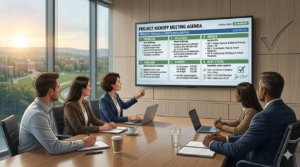
Create a simple one-page agenda:
KICKOFF MEETING AGENDA
Project: [Name]
Date: [Monday date]
Duration: 60 minutes
Attendees: [List]
- Introductions & Roles (5 min)
- Who’s who on both sides
- Decision makers vs. implementers
- Project Overview (10 min)
- Restate the problem we’re solving
- Confirm desired outcomes
- Review timeline and milestones
- Success Metrics (10 min)
- How will we know this worked?
- What does “done” look like?
- Key performance indicators
- Discovery Phase Plan (15 min)
- Who I need to interview (get names)
- Documents I need to review (get access)
- Timeline for discovery (week 1-2)
- Communication & Logistics (10 min)
- Weekly check-in time (schedule now)
- Preferred communication (email? Slack? Text?)
- Response time expectations
- How to escalate urgent issues
- Questions & Next Steps (10 min)
- Open floor for their questions
- Confirm action items
- Schedule next meeting
Send this agenda 24 hours before the meeting.
Why this works:
✓ You control the conversation
✓ You cover everything important
✓ You avoid awkward silences
✓ You demonstrate competence immediately
Monday Morning: The Kickoff Call
You’re on the call. Here’s how to run it:
Opening (5 minutes)
You say:
“Thanks everyone for making time. I’m excited to get started.
Before we dive in, let’s do quick intros. I’m Bob—I’ve spent 30 years in operations, and I’ve helped [X] companies solve [similar problem]. My goal here is to [outcome they hired you for].
Who wants to go next?”
[Let everyone introduce themselves.]
Why this works:
✓ You establish credibility quickly
✓ You understand who’s in the room
✓ You set collaborative tone (not top-down)
Project Overview (10 minutes)
You say:
“Let me make sure I’m clear on what we’re solving for.
Based on our earlier conversations, the challenge is [problem in their words]. The impact of not solving this is [cost/consequence]. Our goal is to [desired outcome].
Over the next [timeline], we’ll [brief overview of approach]. By the end, you’ll have [key deliverables].
Does that align with how you’re thinking about this?”
[Let them confirm or correct.]
Why this works:
✓ Confirms everyone’s on the same page
✓ Prevents scope creep later (“But we thought you were doing X…”)
✓ Gives them chance to course-correct now
Success Metrics (10 minutes)
You ask:
“How will we know this project was successful?
If we’re sitting here three months from now and you’re thrilled with the results, what changed? What metrics improved?”
[Let them talk. Write down everything they say.]
Then you summarize:
“So success looks like:
- [Metric 1: e.g., 30% reduction in bottlenecks]
- [Metric 2: e.g., Clear ownership of all major projects]
- [Metric 3: e.g., Leadership spending 50% less time firefighting]
That sound right?”
Why this matters:
✓ You’re creating measurable success criteria
✓ You’re managing expectations
✓ You’ll reference these at the end to prove ROI
Write these down. You’ll need them when you deliver final results.
Discovery Phase Plan (15 minutes)
You say:
“To get this right, I need to understand how things work today. That means interviews with key people and reviewing some documentation.
Who should I talk to? I’m thinking:
- [Role 1: e.g., Department heads]
- [Role 2: e.g., Frontline managers]
- [Role 3: e.g., Key individual contributors]
Who else am I missing?”
[Get specific names. Add them to your list.]
Then ask:
“What documents should I review? I’m thinking:
- Current process documentation (if it exists)
- Org charts
- Project tracking systems
- Past reports or analyses on this issue
What else would be helpful?”
[Get access to everything.]
Why this works:
✓ You’re gathering what you need to deliver
✓ You’re involving them (not dictating)
✓ You’re demonstrating thoroughness
Communication & Logistics (10 minutes)
You say:
“Let’s talk about how we’ll stay connected.
I’d like to do a weekly check-in—30 minutes, same time every week. What day/time works best for your team?”
[Schedule it on the call. Send calendar invite before you hang up.]
Then ask:
“For day-to-day communication—email? Slack? What’s easiest for you?”
[Match their preference. Don’t force your tools on them.]
Finally:
“If something urgent comes up between our weekly calls, what’s the best way to reach you?”
[Get their cell/direct line.]
Why this matters:
✓ Prevents “I haven’t heard from you” anxiety
✓ Sets clear expectations on response times
✓ Makes you accessible without being constantly interrupted
Close (10 minutes)
You say:
“Questions before we wrap?”
[Answer anything they ask.]
Then:
“Perfect. Here’s what happens next:
This week, I’ll be doing discovery interviews. I’ll reach out to [names] to schedule those. I’ll also review the documents you’re giving me access to.
Next Monday, same time, we’ll do our first weekly check-in. I’ll share what I’m learning and any initial observations.
Sound good?”
[Confirm.]
Before you hang up:
“I’ll send meeting notes within 24 hours summarizing what we discussed and confirming action items. Thanks for your time today. Looking forward to diving in.”
Why this works:
✓ Clear next steps (no ambiguity)
✓ Immediate action (discovery starts this week)
✓ Follow-up promised (meeting notes)
Confidence. Professionalism. Competence.
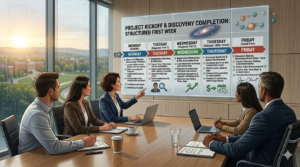
Tuesday-Thursday: Discovery Interviews
You’re gathering information. Here’s how to do it right:
Interview Structure (45-60 minutes each)
Opening (5 min): “Thanks for making time. I’m working with [leadership] on [project]. I’d love to hear your perspective on how things work today and what could be better.”
Their Story (15 min): “Tell me about your role. What does a typical day look like?”
[Let them talk. Take notes.]
Problem Exploration (20 min): “What’s working well right now?”
“What’s not working as well as it could?”
“If you could wave a magic wand and fix one thing, what would it be?”
“What’s been tried before? What happened?”
Impact Questions (10 min): “How does [the problem] affect your work specifically?”
“How much time do you spend dealing with this per week?”
“What would change if this problem went away?”
Close (5 min): “Is there anything I didn’t ask that I should have?”
“Who else should I talk to?”
“Can I follow up if I have more questions?”
Why this structure works:
✓ People love talking about their problems (you’ll get honest insights)
✓ You’re hearing from people who live the problem daily (not just leadership’s view)
✓ You’re gathering stories and examples (not just opinions)
Tip: Record interviews (with permission) so you can be fully present instead of frantically scribbling notes.
Document Review
While you’re doing interviews, also review:
- Process documentation
- Org charts
- Meeting notes
- Project tracking systems
- Previous consultant reports (if any)
- Performance metrics
Look for:
✓ Gaps between “how it’s supposed to work” and “how it actually works”
✓ Patterns across interviews (if 5 people mention the same issue, it’s real)
✓ Root causes (not just symptoms)
✓ Quick wins (things you can fix easily for early momentum)
Friday: Synthesis & Planning
End of Week 1. Here’s what you do:
Task 1: Organize Your Findings
Create a simple document:
DISCOVERY FINDINGS – WEEK 1
Interviews Completed: [X of Y scheduled]
Key Themes:
- [Theme 1: e.g., “No clear ownership of cross-departmental projects”]
- [Theme 2: e.g., “Communication breaks down between teams”]
- [Theme 3: e.g., “Leadership spends 60% of time firefighting”]
Supporting Evidence:
- [Quote or example from Interview 1]
- [Quote or example from Interview 2]
- [Data point from document review]
Potential Root Causes:
- [Hypothesis 1]
- [Hypothesis 2]
Quick Wins Identified:
- [Quick fix 1]
- [Quick fix 2]
Next Steps:
- Complete remaining interviews
- Validate hypotheses
- Begin solution design
This is for YOU. Not for them yet.
But having this organized by Friday means you’re in control.
Task 2: Prepare for Monday’s Check-In
Create a 5-slide deck (or simple email):
Slide 1: What I Did This Week
- Completed X interviews
- Reviewed Y documents
- Observed Z meetings
Slide 2: What I’m Learning
- Key theme 1
- Key theme 2
- Key theme 3
Slide 3: Early Hypotheses
- Possible root cause 1
- Possible root cause 2 (Frame as hypotheses to validate, not conclusions)
Slide 4: What’s Next
- Remaining discovery activities
- Timeline for completion
- When to expect diagnostic report
Slide 5: Questions for You
- Any clarifications I need
- Additional people to interview
- Documents I’m still missing
Keep it high-level. Save deep-dive for the diagnostic report.
Week 1 Complete: What Success Looks Like

By end of Week 1, you should have:
✅ Professional kickoff completed (agenda followed, expectations set)
✅ Weekly check-in scheduled (recurring meeting on calendar)
✅ 5-10 discovery interviews completed (mix of roles and levels)
✅ Key documents reviewed (understanding current state)
✅ Patterns identified (seeing themes across conversations)
✅ Monday check-in prepared (update ready to share)
✅ Client confidence high (you clearly know what you’re doing)
If you did all this, you crushed Week 1.
The client is thinking: “We made the right choice hiring this person.”
Common First-Week Mistakes (And How to Avoid Them)
Mistake #1: Jumping to Solutions Too Fast
Don’t: Show up Monday with “Here’s what you need to do.”
Do: Spend Week 1 in discovery. Understand before you prescribe.
Why: If you solve the wrong problem brilliantly, you still failed.
Mistake #2: Not Taking Enough Notes
Don’t: Trust your memory. You’ll forget key details.
Do: Write everything down. Record interviews (with permission).
Why: You’ll reference these notes throughout the project.
Mistake #3: Avoiding the Client
Don’t: Hide in your office doing research all week without communication.
Do: Send daily or every-other-day updates. “Quick note: Completed 3 interviews today. Great insights. More tomorrow.”
Why: Radio silence makes clients nervous. Frequent updates build trust.
Mistake #4: Trying to Impress Them
Don’t: Use jargon. Overcomplicate things. Pretend you know everything.
Do: Be clear. Be honest. Say “I don’t know yet, but I’ll find out.”
Why: Authenticity beats fake expertise every time.
Your First Week Checklist
Print this. Check it off as you go:
Before Day 1:
- Welcome email sent
- Project folder created
- Kickoff agenda prepared
- Documents/access requested
Monday – Kickoff:
- Kickoff meeting completed
- Success metrics defined
- Interview list confirmed
- Weekly check-in scheduled
- Meeting notes sent within 24 hours
Tuesday-Thursday – Discovery:
- 5-10 interviews completed
- Key documents reviewed
- Notes organized
- Patterns identified
Friday – Synthesis:
- Findings document created
- Monday check-in prepared
- Quick wins identified
- Next week planned
Throughout Week:
- Daily/every-other-day client updates
- Questions answered promptly
- Professional demeanor maintained
- Confidence projected
What Happens Next (Week 2 Preview)
Week 2 is about:
- Completing discovery
- Validating hypotheses
- Designing initial solutions
- Preparing diagnostic report
But that’s next week’s topic.
For now: Focus on crushing Week 1.
Get through Monday’s kickoff. Do great discovery interviews. End Friday with clear findings.
That’s how you start strong.
Talk Tomorrow
Tomorrow, we’re talking about how to conduct discovery interviews that uncover the REAL problems—not just the symptoms people think are the issue.
Hit reply and tell me: What scares you most about your first week with a client? Kickoff call? Discovery interviews? Not knowing what to do?
I want to know so I can help.
And if you know someone who just landed their first consulting client and is freaking out about Monday, forward this to them. Structure beats panic every time.
— Bob
P.S. That welcome email you send Friday before Week 1? It’s a game-changer. Clients tell me all the time: “That email made us feel so confident we made the right choice.” Do it.
SUBSTACK CATEGORY SUGGESTIONS:
Primary Category: Project Delivery & Management
Tags/Secondary Categories:
- Client Onboarding
- Project Kickoff
- Consulting Delivery
- Discovery Process
- Client Management
SEO METADATA (If Using as Blog Post):
Meta Title: First Week as a Consultant: Complete Playbook (Kickoff to Discovery)
Meta Description: Landed your first consulting client? Here’s exactly what to do from Friday before Week 1 through Friday after—kickoff call, discovery interviews, and setting up for success.
Focus Keyword: first week consultant, consulting project kickoff, client onboarding consultant, discovery phase consulting, how to start consulting project, consulting project management