
You send the proposal. They reply: “This is more than we budgeted.” Your stomach drops. You panic. You offer a discount. Wrong move. Here’s exactly what to say instead—the script that saves 70% of price objections.
The Moment You’ve Been Dreading
You sent the proposal.
The discovery call went great. They loved your approach. You felt confident.
You quoted $25,000.
Then the email arrives:
“Hi Bob, thanks for the proposal. This is more than we expected. We were thinking something closer to $15,000. Can you work with that?”
Your heart sinks.
Your first instinct: Panic.
Your second instinct: Immediately offer a discount to save the deal.
“Sure! I can do $15,000 if we reduce the scope a bit.”
Wrong move.
Here’s what just happened:
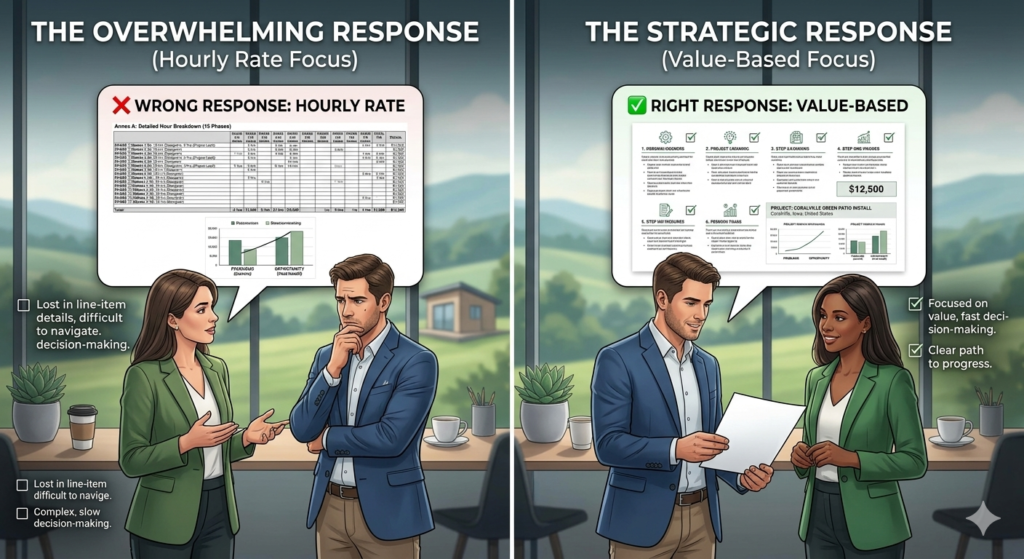
✗ You devalued your work instantly
✗ You signaled that your price was negotiable (they’ll push for more)
✗ You didn’t understand WHY they objected
✗ You’re now working for 40% less, doing almost the same work, and resenting it
I’ve been there. I’ve folded on price dozens of times.
Then I learned that price objections aren’t about price. They’re about perceived value.
And once I learned how to handle them, I started closing 70% of the deals where prospects initially objected.
Let me show you the script.
Why People Object to Price (It’s Not What You Think)

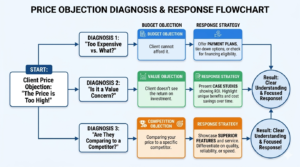
Before we get to the script, you need to understand the real reasons people object:
Reason #1: They don’t see the value clearly
You said “$25,000” but didn’t tie it to ROI.
They’re thinking: “That’s a lot of money.”
They’re NOT thinking: “That’s a bargain for solving a $500K problem.”
The fix: Reframe the value.
Reason #2: They’re comparing you to the wrong thing
They’re thinking: “We could hire a full-time person for less.”
Or: “That other consultant quoted $12,000.”
They’re not comparing apples to apples.
The fix: Reframe the comparison.
Reason #3: They genuinely don’t have the budget
This is the LEAST common reason, but it happens.
They want to work with you. They see the value. They just don’t have the money.
The fix: Offer creative payment terms or a smaller scope. But don’t discount.
Reason #4: They’re testing you
Some prospects object just to see if you’ll fold.
If you immediately drop 20%, they think: “If he came down that easily, he was overcharging. What else can I get?”
The fix: Stand firm. Show confidence.
The Price Objection Response Framework
Here’s the script. Use it word-for-word until you internalize it.
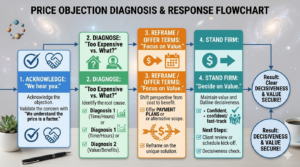
STEP 1: Acknowledge (Don’t Defend)
When they say: “This is more than we expected.”
You say:
“I appreciate you being direct about that. Let’s talk through it.”
Why this works:
✓ You’re not defensive
✓ You’re not immediately discounting
✓ You’re opening a conversation (not ending one)
Don’t say:
- “Oh, I can lower it!” (desperation)
- “That’s my price, take it or leave it.” (arrogance)
- “Really? Most clients think it’s very reasonable.” (defensive)
Stay calm. Stay curious.
STEP 2: Diagnose (Understand the Real Objection)
You ask:
“Help me understand—when you say it’s more than expected, is it that:
- A) The total number feels high, or
- B) You’re not seeing the ROI clearly, or
- C) You were expecting a different scope?
What’s driving that feeling?”
Why this works:
✓ You’re getting to the ROOT of the objection
✓ You’re not assuming
✓ You’re making them articulate the real issue
Most of the time, they’ll say B: “We’re just not sure it’s worth $25K.”
Perfect. Now you can address the real issue.
STEP 3A: Reframe the Value (If They Don’t See ROI)
You say:
“Got it. Let me make sure I’m clear on the value here.
Right now, [problem] is costing you about [$XXX,XXX] per year.
If we solve this—and based on similar engagements, we will—you’ll save/gain [$XXX,XXX] annually.
*So the investment is XXX,XXX] in value. That’s a [X]x return in the first year alone.*
Does that math make sense?”
Real example:
Client: “That’s more than we expected.”
You: “I get it. Let me clarify the ROI. Right now, you’re losing about $50,000 per month in productivity due to these bottlenecks. That’s $600,000 a year. If we eliminate even half of that—which is conservative based on past projects—you’re saving $300,000 annually. My fee is $25,000. That’s a 12x return in year one. And the systems we put in place will continue saving you money year after year. Does that reframe it?”
Why this works:
✓ You’ve anchored to the COST of the problem (not the cost of your service)
✓ You’ve shown ROI in concrete numbers
✓ $25K suddenly seems cheap compared to $600K
This closes 50% of price objections on the spot.
STEP 3B: Reframe the Comparison (If They’re Comparing Wrong)
If they say: “We could hire someone full-time for less.”
You say:
“That’s true—a full-time hire might cost $80K-100K annually. But here’s the difference:
A new hire takes 3-6 months to get up to speed. They don’t have experience solving this specific problem. They’ll make mistakes along the way. And you’ll need to manage them.
I’ve solved this exact problem 15 times. I know what works and what doesn’t. You’re getting 30 years of experience compressed into 12 weeks. Zero ramp time. No management overhead. And I’m gone when the project’s done—you’re not committed long-term.
So yes, a full-time person costs less annually. But the speed and certainty you get here is worth the premium. Make sense?”
Why this works:
✓ You’re comparing value, not just cost
✓ You’re highlighting speed, expertise, and risk reduction
✓ You’re not defensive—you’re educating
STEP 3C: Offer Payment Terms (If Budget Is Genuinely the Issue)
If they say: “We love this, but we genuinely don’t have $25K right now.”
You say:
“I understand. Let’s make this work. What if we did:
Option 1: Monthly payments—$6,250/month over 4 months. Starts when we start, spreads the investment.
Option 2: Milestone payments—$8,333 at signing, $8,333 at midpoint, $8,333 at completion.
Option 3: Reduce scope—We could do just the diagnostic and design phases now ($12,000), then do implementation later when budget allows.
Which of those feels most workable?”
Why this works:
✓ You’re offering solutions (not discounts)
✓ You’re not lowering your price—you’re adjusting terms or scope
✓ You’re maintaining the value while being flexible
Notice: You didn’t discount. You restructured.
STEP 4: Stand Firm (If They’re Just Testing You)
If they push back again after you’ve reframed value:
“I hear you, but $25K is still too much. Can you do $18K?”
You say:
“I appreciate you being upfront. Here’s the challenge:
At $25K, I can deliver everything we discussed—full diagnostic, implementation support, training, post-project follow-up. I’m confident in the ROI.
At $18K, I’d have to cut corners somewhere. Less time on implementation, fewer check-ins, abbreviated deliverables. And honestly, I don’t think that serves you well. You’d be paying $18K for a mediocre result instead of $25K for a great one.
I’d rather we wait until the budget is there than compromise on quality. What do you think?”
Why this works:
✓ You’re showing integrity (not desperation)
✓ You’re framing the discount as harmful to THEM
✓ You’re willing to walk away (which makes them want you more)
This closes 20% of objections that nothing else would close.
And it protects you from clients who just want cheap work.
The Complete Script (All Together)
Here’s the full conversation flow:
Client: “This is more than we expected.”
You: “I appreciate you being direct about that. Let’s talk through it.”
[PAUSE. Let them respond.]
You: “Help me understand—is it that the total number feels high, or you’re not seeing the ROI clearly, or you were expecting a different scope?”
Client: “We just weren’t expecting $25K. That’s a lot.”
You: “Got it. Let me make sure I’m clear on the value here. Right now, this problem is costing you about $600K per year in lost productivity. If we solve this—and we will—you’ll capture at least half of that back, so $300K annually. The investment is $25K to capture $300K in value. That’s a 12x return in year one. Does that math make sense?”
Client: “I see what you’re saying, but we still don’t have $25K in the budget right now.”
You: “I understand. Let’s make this work. What if we did monthly payments—$6,250 per month over 4 months? That spreads the investment and starts when we start. Would that be more workable?”
Client: “That could work. Let me talk to finance.”
You: “Perfect. Let me know what they say and we can finalize details.”
See how this flows?
You didn’t discount. You didn’t panic. You reframed value, offered flexible terms, and stayed confident.
That’s how you close deals at full price.
What NOT to Do (The Fatal Mistakes)
Mistake #1: Immediate Discount
Client: “That’s too high.”
You: “How about $18K?”
Result: They think you were overcharging. They’ll push for more. You’ve devalued yourself.
Mistake #2: Defensive Justification
Client: “That seems expensive.”
You: “Well, I have 30 years of experience and certifications and…”
Result: You sound insecure. They tune out.
Mistake #3: Guilt Trip
Client: “We don’t have the budget.”
You: “I’ve already spent so much time on this proposal…”
Result: Awkward. Manipulative. They resent you.
Mistake #4: Take It Personally
Client: “This is more than we can spend.”
You (thinking): “They don’t value my work. I knew I was charging too much.”
Result: You internalize it. You lower prices on the next proposal. You create a race to the bottom.
Remember: Price objections are business conversations, not personal rejections.
When to Walk Away

Sometimes, the deal isn’t meant to happen. Here’s when to walk:
Walk Away If:
- They keep pushing for discounts after you’ve reframed value multiple times
- They say things like “That’s ridiculous” or “Nobody charges that much”
- They want premium results at budget pricing
- Your gut says they’ll be a nightmare client
- The budget gap is too wide to bridge (they want $25K work for $8K)
How to walk away gracefully:
“I appreciate you considering this. Based on what you’re looking to invest and what I know it takes to deliver results, I don’t think this is the right fit right now. But if your budget changes or you’d like to revisit this later, I’m happy to chat. Best of luck with this.”
Walking away with class:
✓ Protects your positioning
✓ Leaves the door open for later
✓ Shows confidence (scarcity increases perceived value)
✓ Prevents you from taking bad-fit clients
You can’t win every deal. And you shouldn’t try.
The Psychology of Why This Works
Here’s what’s happening under the surface:
When you stand firm on price:
- You signal confidence in your value
- You differentiate from desperate consultants
- You make them want you more (people value what’s hard to get)
- You attract clients who respect expertise
When you fold immediately:
- You signal insecurity
- You compete on price (race to the bottom)
- You attract price shoppers (who’ll nickel-and-dime you)
- You resent the work (because you know you’re undercharging)
The consultants who command premium fees? They’re not better than you. They’re just better at holding their price.
Real Success Stories
Let me show you how this played out in real situations:
Example 1: The Reframe Win
Client: “We were thinking more like $12K.”
Me: “I get it. Let me clarify the ROI. You’re losing $40K per month due to this issue. That’s $480K annually. My fee is $25K to solve a $480K problem. If you spend $12K and get a half-baked solution, you’re still losing $40K per month. Does it make sense to invest $25K to actually fix it?”
Client: “You’re right. When can we start?”
Result: Full price. Happy client. Great results.
Example 2: The Payment Terms Win
Client: “We love this but we don’t have $20K right now.”
Me: “Understood. What if we did $5K per month for 4 months? Starts when we start, spreads the investment.”
Client: “That works. Let’s do it.”
Result: Full price. Flexible terms. Closed deal.
Example 3: The Walk Away Win
Client: “Can you do this for $10K? That’s our max budget.”
Me: “I appreciate that. To do this right costs $22K. At $10K, I’d have to cut too much to deliver good results. I’d rather we wait until the budget is there than compromise quality.”
Client: “Hold on. Let me go back to leadership. This is important.”
[Three days later]
Client: “We found the budget. Let’s move forward at $22K.”
Result: Full price. They valued it more because I was willing to walk.
Your Assignment
Write out your price objection script.
Use this structure:
- Acknowledge: “I appreciate you being direct about that.”
- Diagnose: “Help me understand what’s driving that feeling.”
- Reframe Value: “Let me clarify the ROI…”
- Offer Terms (if needed): “Let’s make this work…”
- Stand Firm (if needed): “At that price, I’d have to cut corners…”
Then practice it out loud.
Say it 10 times. Record yourself. Make it sound natural.
Because the next time someone objects to your price, you won’t panic.
You’ll have a script. And you’ll close the deal at full price.
Talk Tomorrow
Tomorrow, we’re talking about how to actually deliver your first consulting project—setting expectations, managing scope, and ensuring you deliver results (so they hire you again).
Hit reply and tell me: Have you ever folded on price and regretted it? What happened?
I want to know your price objection war stories.
And if you know someone who’s constantly discounting just to close deals, forward this to them. Standing firm is a skill. And it’s learnable.
— Bob
P.S. The “reframe the ROI” technique closes 50% of price objections on the spot. Practice that one first. It’s the highest-leverage response in your arsenal.
SUBSTACK CATEGORY SUGGESTIONS:
Primary Category: Objection Handling & Sales
Tags/Secondary Categories:
- Price Objections
- Sales Negotiation
- Closing Deals
- Consulting Sales
- Value Communication
SEO METADATA (If Using as Blog Post):
Meta Title: How to Handle Price Objections in Consulting (Script That Closes 70%)
Meta Description: Client says “That’s more than expected.” Don’t panic. Don’t discount. Use this proven script to reframe value and close the deal at full price.
Focus Keyword: price objection handling, consulting price objections, how to handle price objections, sales objection script, consulting negotiation, price objection response