
How to Price Your Consulting Services (Without Undercharging or Scaring Clients Away)
You have no idea what to charge. One number feels too low. Another feels scary. So you throw out a number and hope they say yes. Here’s the framework for pricing that respects your expertise and actually closes deals.
The Question That Keeps You Up at Night
You’re about to send that proposal.
You’ve written the scope. Outlined the approach. Described the outcome.
Now you need to fill in the number.
Investment: _______
And you freeze.
What do I charge? What if it’s too much and they walk away? What if it’s too little and I leave money on the table? What if they laugh at me?
So you do one of three things:
Option 1: You lowball to make sure you get the deal.
Result: You get the client. You work far more hours than you priced for. You resent the project.
Option 2: You charge what feels “reasonable.”
Result: They accept immediately without hesitation. Which means you undercharged.
Option 3: You avoid pricing altogether. “It depends on scope. Let’s discuss.”
Result: They move on to someone who can give them a straight answer.
Pricing is the difference between a hobby and a business.
And it’s one of the most common places new consultants get stuck.
Here’s a better way to think about it.

The Three Deadly Pricing Mistakes
Before I give you the framework, let me show you what NOT to do:
Mistake #1: Hourly Pricing
“I charge by the hour.”
Why this fails:
✗ You’re penalized for being efficient (faster work = less money)
✗ You’re incentivized to work slowly (more hours = more money)
✗ Clients watch the clock (“Is this hour really worth it?”)
✗ Your income is capped by hours in a day
✗ You can’t scale (no leverage)
Hourly pricing commoditizes your expertise. You’re selling time, not transformation.
Mistake #2: Pricing Based on What You “Need”
“I need to make a certain amount this year, so I’ll divide it by the number of clients I hope to get.”
Why this fails:
✗ Your financial needs have nothing to do with client value
✗ Arbitrary numbers don’t reflect the market
✗ Clients can smell desperation
✗ You haven’t considered what the work is actually worth
Your mortgage payment is not a pricing strategy.
Mistake #3: Pricing Based on What You Made as an Employee
“I’ll take my old salary, turn it into an hourly rate and add a bit for overhead.”
Why this fails:
✗ You’re not an employee anymore (no benefits, no security)
✗ You have overhead, taxes, unbillable time
✗ Your corporate salary was artificially low (company captured most of your value)
✗ Consulting delivers concentrated value in short timeframes
Your old salary has zero correlation to your consulting value.

The Value-Based Pricing Framework
Here’s how to actually price your services:
Step 1: Calculate the Value You Create (Or Cost You Prevent)
Ask yourself:
If they DON’T solve this problem, what does it cost them?
Examples (illustrative only):
Operations consultant: a company is losing productivity every month to inefficient processes. Fixing it is worth a lot to them over a year, and your fee is a small share of that value.
Sales consultant: a sales team is closing fewer deals than it could. Closing part of that gap is worth far more than your fee.
HR consultant: a company risks losing key people during a merger. Replacing them would be expensive, so helping keep them is valuable.
The formula:
Value Created or Cost Prevented = Your Pricing Anchor
Your fee = a small share of that annual value (depending on complexity, risk and timeline)
Why this works:
When your fee is small next to the cost of the problem, the decision gets much easier.
When you charge by the hour, they have no context for whether that’s worth it.
Price to value. Not to time.
Step 2: Package It (Don’t Sell Hours)
Instead of: “I charge by the hour for consulting.”
Say: “I offer a 12-week Operations Optimization program for one fixed fee.”
What’s included in the package:
- Discovery and diagnostic (weeks 1-2)
- Solution design (weeks 3-4)
- Implementation support (weeks 5-10)
- Optimization and handoff (weeks 11-12)
- Deliverables: Diagnostic report, process documentation, team training, 30-day post-project support
Why this works:
✓ They see a complete solution (not piecemeal hours)
✓ You’re free to work efficiently (incentivized to be fast, not slow)
✓ Price sounds reasonable for 12 weeks of transformation
✓ You can raise prices as you get faster (more profit, same value)
Packages create perceived value. Hours create cost anxiety.
Step 3: Create Pricing Tiers (Give Them Options)
Don’t give them one price. Give them three.
Why? Because people hate binary choices (yes/no) but love comparative choices (which one?).
Example pricing tiers:
OPTION 1: DIAGNOSTIC ONLY (lowest fee)
“Not sure if this is the right solution? Start here.”
What’s included:
- 2-week diagnostic engagement
- Stakeholder interviews (5-7 people)
- Process mapping and analysis
- Written report with findings and recommendations
- 90-minute presentation to leadership
Deliverable: You get the roadmap. You implement internally.
Best for: Companies that want to understand the problem before committing to a solution.
OPTION 2: DONE WITH YOU (middle fee)
“We design it together. You implement it with my guidance.”
What’s included:
- Everything in Option 1, plus:
- 12-week implementation partnership
- Bi-weekly strategy sessions
- Solution design and documentation
- Manager training (2 sessions)
- Email/Slack support throughout
- 30-day post-project check-ins
Deliverable: You get the system designed and your team trained to implement.
Best for: Companies with capable internal teams who need expert guidance.
OPTION 3: DONE FOR YOU (highest fee)
“I handle everything. You focus on running the business.”
What’s included:
- Everything in Option 2, plus:
- Hands-on implementation (I do the work)
- Weekly team meetings
- Direct stakeholder management
- Change management support
- 60-day post-project optimization support
- Priority access (text/call)
Deliverable: Fully implemented system. Turnkey solution.
Best for: Companies without internal bandwidth who need this done fast.
What happens psychologically:
Many people choose the middle option.
Some will say “We can’t afford that” and choose Option 1 (you still have a client).
Some will say “We need this done fast” and choose Option 3.
With only one price, some of them might simply walk away.
Three options give people a choice instead of a yes/no.

How to Know If Your Price Is Right
Here are the signals:
You’re Priced Too Low If:
- They accept immediately without any hesitation or questions
- They say “That’s very reasonable” before you’ve finished explaining
- You’re working 60+ hours and making less than your old salary
- You feel resentful during the project
- You can’t afford to turn down bad-fit clients
Action: Raise your price on the next proposal.
You’re Priced Too High If:
- Everyone says “That’s more than we expected” and walks away
- Very few of your proposals are accepted
- Prospects keep asking for payment plans or discounts
- You’re competing only on price (not value)
Action: Either lower price OR better articulate value (usually the latter).
You’re Priced Just Right If:
- A healthy share of qualified prospects say yes
- Occasional pushback on price, but they move forward anyway
- Some clients pay without hesitation, others negotiate
- You’re comfortable with the revenue you’re generating
- You can be selective about which clients you take
If nearly everyone says yes, you’re probably undercharging.
If hardly anyone says yes, either your price is wrong OR you’re talking to the wrong prospects.
How This Looks in Different Specialties (illustrative examples)
Operations consultant (manufacturing): a company growing quickly is hitting operational chaos. Three tiers: a two-week diagnostic, a 12-week “done with you” program, and a hands-on “done for you” version.
CFO advisor (startups): a growing startup needs financial systems but can’t afford a full-time CFO. Three tiers: a one-time financial health check, a part-time monthly arrangement, and an ongoing fractional role.
HR consultant (mergers): a company acquiring another risks losing key talent. Three tiers: a retention risk assessment, an integration support engagement, and full integration management.
See the pattern?
Price is anchored to value created or cost prevented.
Packaged into clear deliverables.
Offered in three tiers.
The result: prices that make sense to the client, and more confidence for you.
The Confidence Issue (And How to Fix It)

Example: Linda is a hypothetical retiree used to illustrate a common worry, not a real client.
Linda, a retired operations manager (example): “I’ve never charged a fee this size for anything. I feel like a fraud.”
That feeling is very common.
Here’s what can help:
- Your employer likely billed clients far more than your salary for your work
Your expertise was creating value well beyond your paycheck.
You’re just cutting out the middleman now.
- You’re not charging for time, you’re charging for outcomes
A surgeon doesn’t charge by the hour. They charge for saving your life.
You’re not selling hours. You’re selling results.
“I can fix the problem that’s costing you a lot every year” is worth a real fee.
- The first time is the hardest
Saying a bigger number for the first time feels impossible.
But after you do it once and they say yes, it gets easier.
And after you deliver results and they thank you, you’ll realize you were actually undercharging.
Practice saying your price out loud until it doesn’t make you flinch.
- You can always come down, you can rarely go up
If you quote a higher fee and they say “That’s too much,” you can offer payment plans or a smaller scope.
But if you quote low and they say yes immediately, you can’t go back and raise it.
Start high. Negotiate down if needed.
Payment Terms That Reduce Risk
Don’t ask for 100% upfront. Structure payments to reduce their risk:
For project-based work:
Option 1: 50/50 split
- 50% upon signing
- 50% at project completion
Option 2: Thirds
- 33% upon signing
- 33% at midpoint milestone
- 33% at completion
Option 3: Monthly (for longer engagements)
- Equal monthly payments (for example, the total fee split over 4 months)
Why this works:
- Reduces their risk (they’re not paying for work you haven’t done yet)
- Increases your close rate (smaller initial commitment)
- Ensures cash flow throughout the project
- Protects you (they’ve already paid for work completed)
A common approach: 50% upfront, 50% at completion for projects under 3 months.
For projects over 3 months: Monthly payments.
Your Pricing Assignment
Answer these questions for your consulting service:
- What problem do you solve?
Be specific. Not “operations consulting.” But “preventing productivity loss during scale from 50 to 100 employees.”
- What’s the annual cost if they DON’T solve it?
In dollars. Lost revenue? Wasted costs? Opportunity cost?
- What fee is a small, fair share of that annual value?
The bigger the cost of the problem, the more room there is for a fair fee.
- Create three pricing tiers:
- Diagnostic only (low commitment)
- Done with you (medium involvement)
- Done for you (full service)
- Practice saying your price out loud.
Say it 10 times to yourself. Until it doesn’t make you flinch.
Then put it on your next proposal.
What to Say When They Say “That’s More Than I Expected”
You send the proposal. They reply: “This is more than we budgeted.” Your stomach drops. You panic. You offer a discount. Wrong move. Here’s exactly what to say instead.
The Moment You’ve Been Dreading
You sent the proposal.
The discovery call went great. They loved your approach. You felt confident.
You quoted your fee.
Then the email arrives:
“Hi, thanks for the proposal. This is more than we expected. We were thinking of something quite a bit lower. Can you work with that?”
Your heart sinks.
Your first instinct: Panic.
Your second instinct: Immediately offer a discount to save the deal.
“Sure! I can come down if we reduce the scope a bit.”
Wrong move.
Here’s what just happened:
✗ You devalued your work instantly
✗ You signaled that your price was negotiable (they’ll push for more)
✗ You didn’t understand WHY they objected
✗ You’re now working for much less, doing almost the same work, and resenting it
Most new consultants have been there. Folding on price is a common reflex.
But here’s the thing: price objections aren’t about price. They’re about perceived value.
And once you know how to handle them, an objection becomes the start of a conversation, not the end of the deal.
Let me show you the script.
Why People Object to Price (It’s Not What You Think)

Before we get to the script, you need to understand the real reasons people object:
Reason #1: They don’t see the value clearly
You named your fee but didn’t tie it to ROI.
They’re thinking: “That’s a lot of money.”
They’re NOT thinking: “That’s a bargain for solving a problem this expensive.”
The fix: Reframe the value.
Reason #2: They’re comparing you to the wrong thing
They’re thinking: “We could hire a full-time person for less.”
Or: “That other consultant quoted less.”
They’re not comparing apples to apples.
The fix: Reframe the comparison.
Reason #3: They genuinely don’t have the budget
This is the LEAST common reason, but it happens.
They want to work with you. They see the value. They just don’t have the money.
The fix: Offer creative payment terms or a smaller scope. But don’t discount.
Reason #4: They’re testing you
Some prospects object just to see if you’ll fold.
If you immediately drop your price, they think: “If he came down that easily, he was overcharging. What else can I get?”
The fix: Stand firm. Show confidence.
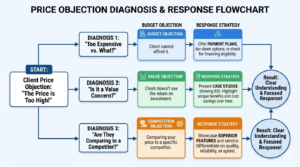
The Price Objection Response Framework
Here’s the script. Use it word-for-word until you internalize it.
STEP 1: Acknowledge (Don’t Defend)
When they say: “This is more than we expected.”
You say:
“I appreciate you being direct about that. Let’s talk through it.”
Why this works:
✓ You’re not defensive
✓ You’re not immediately discounting
✓ You’re opening a conversation (not ending one)
Don’t say:
- “Oh, I can lower it!” (desperation)
- “That’s my price, take it or leave it.” (arrogance)
- “Really? Most clients think it’s very reasonable.” (defensive)
Stay calm. Stay curious.
STEP 2: Diagnose (Understand the Real Objection)
You ask:
“Help me understand—when you say it’s more than expected, is it that:
- A) The total number feels high, or
- B) You’re not seeing the ROI clearly, or
- C) You were expecting a different scope?
What’s driving that feeling?”
Why this works:
✓ You’re getting to the ROOT of the objection
✓ You’re not assuming
✓ You’re making them articulate the real issue
Often, they’ll say B: “We’re just not sure it’s worth it.”
Perfect. Now you can address the real issue.
STEP 3A: Reframe the Value (If They Don’t See ROI)
You say:
“Got it. Let me make sure I’m clear on the value here.
Right now, this problem is costing you a significant amount every year.
If we solve it, you can keep a good part of that money.
So the investment is small compared with the value at stake.
Does that math make sense?”
Illustrative example:
Client: “That’s more than we expected.”
You: “I get it. Let me clarify the ROI. Right now, these bottlenecks are costing you productivity every single month. Over a year, that adds up to far more than my fee. If we remove even part of it, the project pays for itself, and the systems keep helping year after year. Does that reframe it?”
Why this works:
✓ You’ve anchored to the COST of the problem (not the cost of your service)
✓ You’ve shown the ROI in their own terms
✓ Your fee looks small next to the cost of the problem
This can resolve the objection on the spot.
STEP 3B: Reframe the Comparison (If They’re Comparing Wrong)
If they say: “We could hire someone full-time for less.”
You say:
“That’s true—a full-time hire might cost less over a year. But here’s the difference:
A new hire takes 3-6 months to get up to speed. They don’t have experience solving this specific problem. They’ll make mistakes along the way. And you’ll need to manage them.
I’ve worked on this kind of problem before. I know what tends to work and what doesn’t. You’re getting decades of experience compressed into 12 weeks. Zero ramp time. No management overhead. And I’m gone when the project’s done—you’re not committed long-term.
So yes, a full-time person costs less annually. But the speed and certainty you get here is worth the premium. Make sense?”
Why this works:
✓ You’re comparing value, not just cost
✓ You’re highlighting speed, expertise, and risk reduction
✓ You’re not defensive—you’re educating
STEP 3C: Offer Payment Terms (If Budget Is Genuinely the Issue)
If they say: “We love this, but we genuinely don’t have the budget right now.”
You say:
“I understand. Let’s make this work. What if we did:
Option 1: Monthly payments—the same fee split over 4 months. Starts when we start, spreads the investment.
Option 2: Milestone payments—one third at signing, one third at midpoint, one third at completion.
Option 3: Reduce scope—We could do just the diagnostic and design phases now, then do implementation later when budget allows.
Which of those feels most workable?”
Why this works:
✓ You’re offering solutions (not discounts)
✓ You’re not lowering your price—you’re adjusting terms or scope
✓ You’re maintaining the value while being flexible
Notice: You didn’t discount. You restructured.
STEP 4: Stand Firm (If They’re Just Testing You)
If they push back again after you’ve reframed value:
“I hear you, but it’s still too much. Can you knock a big chunk off?”
You say:
“I appreciate you being upfront. Here’s the challenge:
At the price I quoted, I can deliver everything we discussed—full diagnostic, implementation support, training, post-project follow-up. I’m confident in the ROI.
At a much lower price, I’d have to cut corners somewhere. Less time on implementation, fewer check-ins, abbreviated deliverables. And honestly, I don’t think that serves you well. You’d be paying less for a mediocre result instead of a fair price for a great one.
I’d rather we wait until the budget is there than compromise on quality. What do you think?”
Why this works:
✓ You’re showing integrity (not desperation)
✓ You’re framing the discount as harmful to THEM
✓ You’re willing to walk away (which makes them want you more)
Sometimes this wins deals that nothing else would.
And it protects you from clients who just want cheap work.
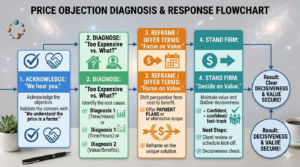
The Complete Script (All Together)
Here’s the full conversation flow:
Client: “This is more than we expected.”
You: “I appreciate you being direct about that. Let’s talk through it.”
[PAUSE. Let them respond.]
You: “Help me understand—is it that the total number feels high, or you’re not seeing the ROI clearly, or you were expecting a different scope?”
Client: “We just weren’t expecting that number. That’s a lot.”
You: “Got it. Let me make sure I’m clear on the value here. Right now, this problem is costing you a lot in lost productivity every year. If we solve it, you get much of that back, and the fee is small by comparison. Does that make sense?”
Client: “I see what you’re saying, but we still don’t have it in the budget right now.”
You: “I understand. Let’s make this work. What if we split the fee into monthly payments over 4 months? That spreads the investment and starts when we start. Would that be more workable?”
Client: “That could work. Let me talk to finance.”
You: “Perfect. Let me know what they say and we can finalize details.”
See how this flows?
You didn’t discount. You didn’t panic. You reframed value, offered flexible terms, and stayed confident.
That’s how you close deals at full price.
What NOT to Do (The Fatal Mistakes)
Mistake #1: Immediate Discount
Client: “That’s too high.”
You: “How about I knock a big chunk off?”
Result: They think you were overcharging. They’ll push for more. You’ve devalued yourself.
Mistake #2: Defensive Justification
Client: “That seems expensive.”
You: “Well, I have 30 years of experience and certifications and…”
Result: You sound insecure. They tune out.
Mistake #3: Guilt Trip
Client: “We don’t have the budget.”
You: “I’ve already spent so much time on this proposal…”
Result: Awkward. Manipulative. They resent you.
Mistake #4: Take It Personally
Client: “This is more than we can spend.”
You (thinking): “They don’t value my work. I knew I was charging too much.”
Result: You internalize it. You lower prices on the next proposal. You create a race to the bottom.
Remember: Price objections are business conversations, not personal rejections.
When to Walk Away

Sometimes, the deal isn’t meant to happen. Here’s when to walk:
Walk Away If:
- They keep pushing for discounts after you’ve reframed value multiple times
- They say things like “That’s ridiculous” or “Nobody charges that much”
- They want premium results at budget pricing
- Your gut says they’ll be a nightmare client
- The budget gap is too wide to bridge (they want the full project for a fraction of the fee)
How to walk away gracefully:
“I appreciate you considering this. Based on what you’re looking to invest and what I know it takes to deliver results, I don’t think this is the right fit right now. But if your budget changes or you’d like to revisit this later, I’m happy to chat. Best of luck with this.”
Walking away with class:
✓ Protects your positioning
✓ Leaves the door open for later
✓ Shows confidence (scarcity increases perceived value)
✓ Prevents you from taking bad-fit clients
You can’t win every deal. And you shouldn’t try.
The Psychology of Why This Works
Here’s what’s happening under the surface:
When you stand firm on price:
- You signal confidence in your value
- You differentiate from desperate consultants
- You make them want you more (people value what’s hard to get)
- You attract clients who respect expertise
When you fold immediately:
- You signal insecurity
- You compete on price (race to the bottom)
- You attract price shoppers (who’ll nickel-and-dime you)
- You resent the work (because you know you’re undercharging)
The consultants who command premium fees? They’re not better than you. They’re just better at holding their price.
Example Scenarios
Illustrative examples: The conversations below are hypothetical scenarios that show how the script can sound. The clients and fees are illustrations, not real results. See our Earnings Disclaimer.
Example 1: The Reframe Win
Client: “We were thinking of about half that.”
You: “I get it. Let me clarify the ROI. This issue is costing you every month, and over a year it adds up to far more than my fee. If you spend less and get a half-baked solution, you’re still losing that money every month. Does it make sense to invest enough to actually fix it?”
Client: “You’re right. When can we start?”
Result: Full price, and a client who understands the value.
Example 2: The Payment Terms Win
Client: “We love this but we don’t have the budget right now.”
You: “Understood. What if we split the fee over 4 months? Starts when we start, spreads the investment.”
Client: “That works. Let’s do it.”
Result: Full price. Flexible terms. Closed deal.
Example 3: The Walk Away Win
Client: “Can you do this for less than half? That’s our max budget.”
You: “I appreciate that. To do this right costs what I quoted. At that budget, I’d have to cut too much to deliver good results. I’d rather we wait until the budget is there than compromise quality.”
Client: “Hold on. Let me go back to leadership. This is important.”
[Three days later]
Client: “We found the budget. Let’s move forward.”
Result: Full price. They valued it more because you were willing to walk.
Your Assignment
Write out your price objection script.
Use this structure:
- Acknowledge: “I appreciate you being direct about that.”
- Diagnose: “Help me understand what’s driving that feeling.”
- Reframe Value: “Let me clarify the ROI…”
- Offer Terms (if needed): “Let’s make this work…”
- Stand Firm (if needed): “At that price, I’d have to cut corners…”
Then practice it out loud.
Say it 10 times. Record yourself. Make it sound natural.
Because the next time someone objects to your price, you won’t panic.
You’ll have a script, and a much better chance of closing at a fair price.
Talk Tomorrow
Tomorrow, we’re talking about handling the price objection—what to say when they respond with “That’s more than I expected” or “We don’t have that in the budget.”
Hit reply and tell me: What are you currently charging? And does it feel too low, too high, or just right?
I want to know where you are so I can help you price with confidence.
And if you know someone who’s undercharging and overworking, forward this to them. Pricing is permission to be profitable.
— Bob
P.S. Three-tier pricing can help. Some people upgrade. Some people downgrade. But almost everyone picks an option instead of walking away. Test it.
Some links on this site may be affiliate links; if you buy through one, we may earn a commission at no extra cost to you. See our Affiliate Disclosure. Any income examples are illustrative, not typical or guaranteed. See our Earnings Disclaimer.
Get the Weekly Rewiring Report
One practical, no-hype idea a week for building your second act. Unsubscribe anytime.
Free. Unsubscribe anytime. We never share your email. See our Privacy Policy.