
The $27 Product That Sold Zero Copies (And What It Taught Me About Pricing)
Here’s a painful story about pricing gone wrong:
A retired CPA created an incredible spreadsheet system for tracking small business expenses. Saved his clients thousands. Took him 30 years to perfect.
He packaged it up, wrote a simple sales page, and listed it for $27.
His thinking? “It’s just a spreadsheet. I can’t charge too much.”
Result: Zero sales in the first month.
He panicked. Dropped the price to $17. Then $9.95.
Still nothing.
Then I asked him one question that changed everything:
“How much money does your spreadsheet save the average business owner per year?”
His answer: “Probably $3,000 to $5,000 in tax deductions they’d otherwise miss.”
I told him to change the price to $197 and rewrite the sales page to focus on the $5,000 in savings, not the spreadsheet.
New result: 23 sales in the first week.
Same product. Higher price. Better positioning. Completely different outcome.
Here’s what most new online business owners get catastrophically wrong about pricing—and how to fix it before you launch anything.
The Fatal Pricing Mistake (And Why You’re Probably Making It)
Most people price their products based on what they think people will pay, not the value they’re actually delivering.
This leads to three catastrophic errors:
Error #1: Pricing Too Low (The “Race to the Bottom”)
You think: “I’m new, so I should charge less to attract buyers.”
What actually happens:
- Low prices signal low quality
- Bargain hunters buy but never implement (then complain)
- You need 10X more sales to hit your income goals
- You attract price shoppers, not serious buyers
The psychology: When people see a $7 course on “How to Start a Consulting Business,” their brain thinks:
“If this actually worked, it would cost more. This must be basic/incomplete/scammy.”
Error #2: Pricing Based on “Stuff” Instead of Outcomes
You think: “It’s just 4 videos and a PDF, so I can’t charge much.”
Wrong.
Your customers don’t care about the number of videos. They care about what those videos help them achieve.
Bad pricing logic:
- “4 videos + 1 PDF = $27”
Good pricing logic:
- “System that helps retirees land their first 3 clients in 30 days = $297”
Same product. Different frame. 10X price difference.
Error #3: Being Afraid to Charge What You’re Worth
This is the big one.
You’ve got decades of experience. You’ve solved real problems. You know things other people desperately need to know.
But you think: “Who am I to charge $297? I’m not some big-name guru.”
Here’s the truth: Your customers don’t need you to be famous. They need you to solve their problem.
And if you can solve a $5,000 problem, charging $297 is a bargain—not a rip-off.
The Pricing Formula That Actually Works
Here’s the exact framework Kevin Fahey teaches for pricing any online product:
Step 1: Calculate the “Value Gap”
Ask yourself:
“What is the financial or emotional cost of my customer’s problem?”
Examples:
- Retiree struggling to find clients → Lost income: $2,000/month = $24,000/year
- Small business owner confused by bookkeeping → Potential IRS penalty: $5,000
- Someone struggling with LinkedIn profile → Missed job opportunities: $60,000/year salary
Step 2: Position Your Product as the Bridge
Your price should be a small fraction of the value you deliver.
The formula:
- If you solve a $5,000 problem → Charge $197-$497
- If you solve a $24,000 problem → Charge $497-$1,997
- If you solve a $60,000 problem → Charge $997-$4,997
Why this works:
- Customers see massive ROI (10X-50X return)
- You’re positioned as premium and valuable
- You attract serious buyers who will actually implement
Step 3: Use the “Price Point Ladder” Strategy
From Kevin’s 50K Case Study framework, here are the proven price points that convert:
Low-Ticket Entry Products:
- $17 (minimum—anything lower signals “cheap”)
- $27 (sweet spot for impulse buys)
- $47 (great for mini-courses/challenges)
Mid-Ticket Core Products:
- $97 (comprehensive courses)
- $147-$197 (flagship courses with implementation)
- $297 (premium courses/group programs)
High-Ticket Transformation Products:
- $497-$997 (coaching + course bundles)
- $1,997-$4,997 (group coaching/masterminds)
- $5,000+ (1-on-1 coaching/done-for-you)
Pro Tip from Kevin: The $7 front-end price is too low. It attracts tire-kickers and kills conversions on upsells. Start at $17 minimum.
Real Example: How One Price Change Generated an Extra $43,000

Let me share a case study from Kevin’s students:
Background:
- Retired project manager (age 58) teaching small business owners how to manage remote teams
- Original product: “Remote Team Management Toolkit”
- Original price: $37
- Sales in first 90 days: 47 copies = $1,739
The Intervention:
I asked him: “What does bad remote team management cost a business owner?”
His answer:
- Miscommunication = Missed deadlines = Lost clients
- Poor productivity = Wasted payroll (est. $10,000/year)
- High turnover = Recruiting costs (est. $15,000/year)
- Total cost of the problem: ~$25,000/year
The Changes:
- Renamed the product: “The $25K Remote Team System: Never Lose Another Client to Miscommunication”
- Repositioned the offer: Focused on the cost of NOT fixing the problem
- Changed the price: $37 → $297
- Added a payment plan: 3 payments of $99
- Included a bonus: 30-minute implementation call ($500 value)
New Results (next 90 days):
- 87 sales at $297 = $25,839
- 34 payment plans (3 x $99) = $10,098
- 12 upsells to group coaching ($997) = $11,964
- Total: $47,901
Same person. Same expertise. Same 90-day window.
The only difference? Pricing and positioning.
The “Confidence Pricing” Method (For When You’re Starting Out)
I get it—you’re thinking: “But I’m new! I don’t have testimonials or a track record yet!”
Fair. Here’s how to price confidently even when you’re just starting:
Strategy #1: The “Founder’s Pricing” Model
Launch at a discount for the first 10-20 buyers in exchange for feedback and testimonials.
Example:
- Regular price: $297
- Founder’s price: $97 (for first 15 buyers)
- Condition: They provide a testimonial and honest feedback
Why this works:
- You still position yourself as premium ($297 anchor)
- Early buyers get a deal and feel special
- You build social proof quickly
- After 15 sales, you raise to full price with testimonials in hand
Strategy #2: The “Guarantee That Removes All Risk” Method
Charge your full price ($197-$497) but offer an iron-clad guarantee:
Examples:
- “Get your first client in 30 days or I’ll refund you AND give you a free 1-on-1 coaching call”
- “If you don’t save at least $1,000 using this system, I’ll refund every penny”
Why this works:
- The guarantee removes the buyer’s risk
- You can charge premium prices without the “proven track record”
- Refund rates are typically <5% if your product delivers value
Strategy #3: The “Pay What You Want (Above $X)” Model
Set a minimum price ($97) and let buyers choose to pay more.
Example:
- Minimum: $97
- Suggested: $197
- Premium: $297 (includes bonus coaching call)
Why this works:
- Removes pricing objections
- Customers self-select into their value perception
- Surprisingly, 20-30% pay ABOVE the minimum
The Pricing Psychology Secrets Nobody Talks About
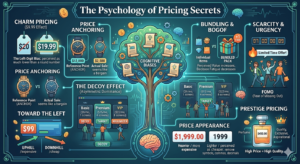
Here are the insider tricks that make your pricing irresistible:
Trick #1: The “Anchoring” Effect
Always show the higher “regular” price crossed out next to your sale price.
Example:
- → $197 (Limited Time)
Why it works: The brain sees $197 as a bargain compared to $497, even if you never actually charged $497.
Trick #2: The “Decoy” Price
Offer three pricing tiers. Make the middle one the most attractive.
Example:
- Basic: $97 (course only)
- Premium: $297 (course + group coaching + bonuses) ← MOST POPULAR
- VIP: $997 (course + 1-on-1 coaching + implementation)
Why it works: Most people avoid the cheapest option (feels incomplete) and the most expensive (feels excessive). The middle option becomes the “obvious choice.”
Trick #3: The “Pain of Paying” Reducer
Break big prices into small daily/weekly costs.
Example: Instead of saying “$297 for the course,” say:
“Less than $1/day for the next year to master remote team management”
Why it works: $297 feels big. $1/day feels trivial.
The “Price Test” Checklist (Use This Before You Launch)
Before you finalize your price, ask yourself these 5 questions:
✅ Does my price reflect the OUTCOME, not the deliverables?
- ❌ “3 videos for $27”
- ✅ “$297 to land your first 3 clients in 30 days”
✅ Would I pay this price to solve this problem?
- If your answer is “no,” your price is either too high OR your offer isn’t compelling enough
✅ Does my price attract serious buyers?
- $7-$17 = Tire-kickers
- $97-$297 = Serious learners
- $497+ = Action-takers who will implement
✅ Can I deliver 10X value vs. what I’m charging?
- If you’re charging $197, can you deliver $1,970 in value? If yes, you’re golden.
✅ Am I pricing based on fear or confidence?
- Fear = “I hope someone buys this”
- Confidence = “This will change their life, and $297 is a steal”

The Bottom Line
Underpricing doesn’t make you generous—it makes you invisible.
Premium pricing doesn’t make you greedy—it makes you credible.
Your decades of experience, your hard-won knowledge, your ability to solve real problems—that has value.
Don’t insult your expertise (or your customers) by charging $27 for a solution to a $25,000 problem.
Charge what you’re worth. Deliver 10X the value. Watch what happens.
Ready to Price Your Offer for Maximum Profit and Impact?
Download my free pricing calculator: “The Perfect Price Formula”—plug in your offer details and get the exact price point that maximizes conversions and positions you as the premium choice.
👉 Get your free pricing calculator here →
Categories:
- Pricing Strategy
- Product Positioning
- Online Business Foundations
Keywords/Tags: pricing strategy, how to price online course, product pricing mistakes, premium pricing psychology, value-based pricing, online course pricing, pricing for retirees, how much to charge for course, pricing confidence, avoid underpricing
📸 IMAGE PROMPTS FOR NANO BANANA
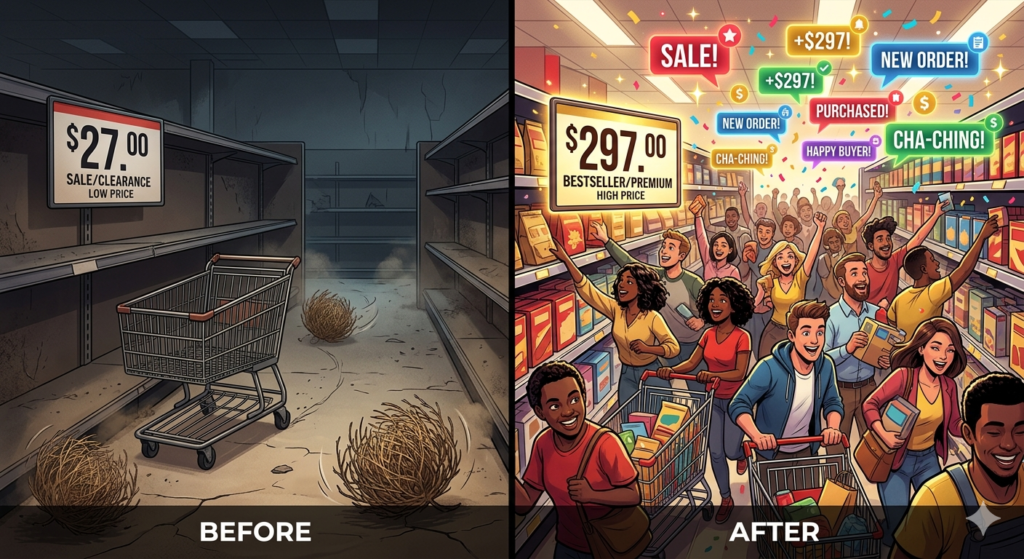
Header/Featured Image: “Before and after split screen: left shows $27 price tag with empty shopping cart and tumbleweeds, right shows $297 price tag with excited buyers and sales notifications popping, dramatic contrast, modern digital illustration, professional”
Mid-Post Image (after “Real Example” section): “Confident senior entrepreneur at desk with calculator and laptop showing $47,901 revenue dashboard, celebrating pricing success, warm home office setting, achievement and validation mood, photorealistic, inspiring”
End-of-Post/CTA Image: “Three-tier pricing display showing Basic, Premium (highlighted with ‘Most Popular’ badge), and VIP options with checkmarks and value indicators, clean modern design, psychology of choice visual, professional illustration”
Why “The Money Is in the List” Is Only Half True (And What Actually Makes You Money)
Meta Description: Everyone says build an email list—but a big list doesn’t guarantee income. Learn the real secret to turning subscribers into buyers and building a list that actually pays.