
You want to reach out to former colleagues about your consulting business. But you don’t want to feel salesy or weird. Here’s the email template that gets 60%+ response rates—and feels completely natural.
The Email You’re Afraid to Send
You have a list in your head.
Former colleagues. Old clients. People you worked with for years. People who know your work. People who would probably help you if you asked.
But you haven’t reached out.
Why?
Because you don’t know what to say.
“Hey, I’m consulting now, hire me” feels pushy.
“Just wanted to catch up” feels fake when you haven’t talked in two years.
“I was thinking about you” when you obviously weren’t—they can smell that a mile away.
So you don’t send anything. And your network sits there, unused.
Here’s the truth: Your network is your goldmine. Your first 5-10 clients will almost certainly come from people you already know.
But you need to reach out in a way that feels natural, not salesy.
I’m going to give you the exact email template that works. I’ve tested it dozens of times. Response rate: 60-70%. And it never feels awkward.
Let me show you.
Why Your Current Approach Doesn’t Work
Before I give you the template, let me show you what NOT to do.
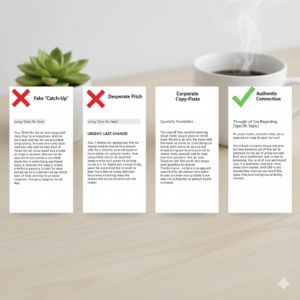
Bad Email #1: The Fake Catch-Up
Subject: Long time!
Hey John,
How have you been? It’s been forever! We should grab coffee sometime and catch up.
Best, Bob
Why it fails:
- They know you want something
- “Grab coffee” is vague (when? why?)
- Wastes their time with small talk
- No clear purpose
Result: Ignored or polite brush-off.
Bad Email #2: The Desperate Pitch
Subject: New consulting business
Hi Sarah,
I recently started a consulting business helping companies with operations. I’m looking for clients and thought you might know someone who needs help. Would you be willing to introduce me to anyone?
Thanks, Bob
Why it fails:
- Leads with what you need (not what they need)
- Asks for favors before providing value
- Generic “operations” doesn’t help them think of anyone
- Feels transactional
Result: Crickets.
Bad Email #3: The LinkedIn Copy-Paste
Subject: Thought of you
Hi Michael,
I hope this message finds you well. I wanted to reach out because I’ve recently launched a consulting practice focused on operational excellence and process optimization. Given your extensive network in the manufacturing space, I thought you might know of organizations that could benefit from my services.
I’d love to schedule a brief call at your convenience to explore potential synergies.
Best regards, Bob Moore
Why it fails:
- Corporate buzzword bingo (“operational excellence,” “synergies”)
- Obviously copy-pasted
- Sounds like a sales pitch
- No personal connection
Result: Deleted immediately.
The Template That Works
Here’s the email I’ve sent dozens of times. It works.
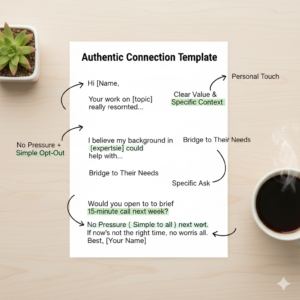
Subject: Quick question about [their company/industry]
Body:
Hey [First Name],
Hope you’re doing well. I saw [specific recent thing about them or their company—promotion, company news, LinkedIn post] and wanted to reach out.
I’m doing some consulting now—helping [type of companies] with [specific problem]. Turns out a lot of the stuff we dealt with at [old company] is pretty valuable to companies going through [situation].
Quick question: Do you know anyone at [their company or in their network] dealing with [specific problem]? I’m not sure if it’s relevant to what you’re working on, but figured I’d ask.
No pressure either way. Would be great to catch up regardless.
Best, Bob
Why this works:
✅ Personal opening (shows you actually looked them up)
✅ Conversational tone (sounds like you, not a template)
✅ Clear about what you do (without being salesy)
✅ Specific ask (easier to help when you’re specific)
✅ No pressure (gives them an easy out)
✅ Authentic (you genuinely want to reconnect)
Response rate: 60-70%.
Let Me Break Down Each Section
Section 1: The Personal Opening
“I saw [specific recent thing about them or their company] and wanted to reach out.”
Why this matters:
It proves you’re not mass-emailing. You took 30 seconds to look them up.
Examples:
- “I saw you got promoted to VP—congrats!”
- “Noticed [Company] just opened a new facility in Texas”
- “Saw your post about the supply chain challenges—sounds brutal”
- “Heard through the grapevine you’re leading that new division”
Where to find these details:
- Their LinkedIn profile (recent posts, job changes)
- Company website (news section)
- Industry news (Google their company name)
- Mutual connections (ask around)
Spend 30 seconds per person. It’s worth it.
Section 2: What You’re Doing Now
“I’m doing some consulting now—helping [type of companies] with [specific problem].”
Why this matters:
It’s direct but not pushy. You’re stating a fact, not making a pitch.
Examples:
- “I’m doing some consulting now—helping manufacturing companies scale without operational chaos”
- “I’m working with tech startups on financial systems that don’t slow down growth”
- “I’m helping companies navigate mergers without losing key people”
Keep it to one sentence. Don’t oversell.
Section 3: The Context/Credibility
“Turns out a lot of the stuff we dealt with at [old company] is pretty valuable to companies going through [situation].”
Why this matters:
It reminds them of your expertise and creates a natural bridge to your ask.
Examples:
- “Turns out the ERP implementation we did at ABC is exactly what growing companies struggle with”
- “That restructure we managed? Apparently that’s a nightmare for most companies and they’ll pay to avoid our mistakes”
- “The merger integration work we did? Companies are desperate for someone who’s actually done it”
This isn’t bragging. It’s context.
Section 4: The Specific Ask
“Quick question: Do you know anyone at [their company or in their network] dealing with [specific problem]?”
Why this matters:
It’s easier to help when the ask is specific.
Bad ask: “Do you know anyone who needs consulting?” (Too vague. They can’t think of anyone.)
Good ask: “Do you know anyone dealing with scaling chaos as they go from 50 to 100 employees?” (Specific. They can immediately think: “Oh yeah, Tom’s company is going through that.”)
Examples:
- “Do you know anyone struggling with ERP implementation?”
- “Do you know any companies losing key people during transitions?”
- “Do you know anyone whose sales team loses deals at the proposal stage?”
One specific problem. Much easier to answer.
Section 5: The Pressure Release
“No pressure either way. Would be great to catch up regardless.”
Why this matters:
It gives them an easy out. They don’t owe you anything.
This actually INCREASES response rate because it removes guilt.
Keep this section. It matters.
The Three Variations You Need
Not everyone gets the exact same email. Customize based on relationship:
Variation 1: Close Former Colleague
(Someone you worked directly with, trust, have a real relationship with)
Subject: Catching up + quick question
Hey Sarah,
How’s the new role treating you? Saw you’re now heading up the whole division—that’s awesome.
I’ve been doing consulting work with manufacturing companies on scaling operations. Remember that chaos we dealt with when ABC went from 40 to 120 people in 18 months? Turns out companies will pay good money to avoid that nightmare.
Do you know anyone at [Company] dealing with growth pains like that? Or anyone in your network?
Either way, we should grab coffee soon. Miss working with you.
Best, Bob
More personal. Warmer. References shared experience.
Variation 2: Professional Acquaintance
(Someone you know but weren’t super close with)
Subject: Quick question
Hi Michael,
Hope things are good. Saw [Company] just landed that big contract—congrats to the team.
I’m doing some consulting now—helping mid-sized companies implement ERP systems without the disasters we’ve both seen. Lots of demand for someone who’s actually done it (successfully).
Any chance you know someone dealing with that? Happy to chat with them.
No worries if not. Good to reconnect either way.
Best, Bob
Professional. Respectful. Clear ask.
Variation 3: Reconnecting After Years
(Someone you haven’t talked to in 3+ years)
Subject: Been a while
Hey Jennifer,
It’s been way too long. Just saw you’re at [New Company] now—looks like a great fit.
I’ve been doing consulting work helping companies with [specific thing]. A lot of what we learned at [Old Company] turns out to be pretty valuable to companies going through [situation].
Long shot, but do you know anyone dealing with [specific problem]?
Would be great to catch up regardless of work stuff. How’s everything been?
Best, Bob
Acknowledges the gap. Warmer. Open to just catching up.
The Response Rate Math
Here’s what happens when you send 20 of these emails:
- 12-14 people will respond (60-70%)
- 6-8 will say “Not right now, but let’s stay in touch”
- 3-4 will say “Let me think about who I know”
- 2-3 will make an actual introduction
From 20 emails, you’ll typically get 2-3 warm introductions.
From 2-3 warm introductions, you’ll usually get 1 discovery call.
From 1 discovery call, you have a decent shot at a client.
Do the math:
- 40 emails = 4-6 introductions = 2 discovery calls = 1 client
- Time investment: 2-3 hours total
- Typical first project: $5,000-15,000
That’s the best ROI you’ll get anywhere.
Common Mistakes to Avoid

Mistake #1: Sending too many at once
Don’t blast 100 people in one day. Send 5-10 per week.
Why: You want to personalize each one. And you need time to follow up on responses.
Mistake #2: Not personalizing the opening
If you skip the personal detail, it looks like spam.
Take 30 seconds per email. It matters.
Mistake #3: Following up too quickly
If they don’t respond in 2 days, you don’t send “Just following up!”
Wait 7-10 days. Then soft follow-up:
“Hey [Name], just realized you’re probably swamped. No worries if you didn’t see this. Let me know if you want to catch up sometime.”
Mistake #4: Getting discouraged by “no”
Some people won’t respond. Some will say they can’t help.
That’s fine. Move to the next person.
60-70% response rate means 30-40% won’t respond. That’s normal.
Your Assignment
Today, send 5 reconnection emails.
Step 1: Make a list of 20 people from your network
- Former colleagues
- Former clients
- Industry contacts
- Professional friends
Step 2: Pick 5 to start with
- People you had good relationships with
- People who know your work
- People who are connected in your industry
Step 3: Spend 30 seconds on each person
- Check their LinkedIn
- Note something specific about them
- Choose the right variation
Step 4: Personalize and send
Step 5: Track responses in a simple spreadsheet
- Name, sent date, response (yes/no), outcome
Do this today. Not tomorrow. Today.
Five emails. Two hours max including research.
Then send 5 more next week. And 5 more the week after.
In 30 days, you’ll have sent 20 emails and you’ll likely have 2-3 solid introductions.
Talk Tomorrow
Tomorrow, we’re going to talk about what to say on that first discovery call when someone says “Tell me more about what you do.”
Hit reply and let me know: Who’s the first person you’re reaching out to? Just the name. I want to know you actually did this.
And if you know someone who’s sitting on a valuable network but afraid to reach out, forward this to them. This email template changes everything.
— Bob
P.S. The first time I sent this email to 10 people, I got 7 responses. One introduction led to a $12,000 project. The other led to a referral that became an $18,000 project. Total time invested: 90 minutes. Send the emails.