
You spend hours crafting a detailed 10-page proposal. You send it. Then… silence. They “need to review it with the team.” Translation: it’s dead. Here’s the one-page proposal that gets decisions fast—and actually gets signed.
The Proposal Black Hole

You just had a great discovery call.
They love your approach. The pricing works. They’re ready to move forward.
You say: “Great! Let me put together a proposal and I’ll send it over by Friday.”
You spend the weekend crafting it. Ten pages. Detailed scope of work. Timeline. Methodology. Your background. Case studies. Terms and conditions.
You send it Monday morning with a subject line: “Proposal for [Project Name] – Looking Forward to Working Together!”
Then… nothing.
Tuesday: No response.
Wednesday: You send a follow-up. “Just wanted to make sure you received this.”
Thursday: They reply. “Yes, got it. We’re reviewing it with the team. Will circle back soon.”
Translation: It’s sitting in someone’s inbox. Unread. Forgotten.
Two weeks later, you send another follow-up.
“Just checking in on this. Any questions I can answer?”
Response: Crickets.
The proposal is dead.
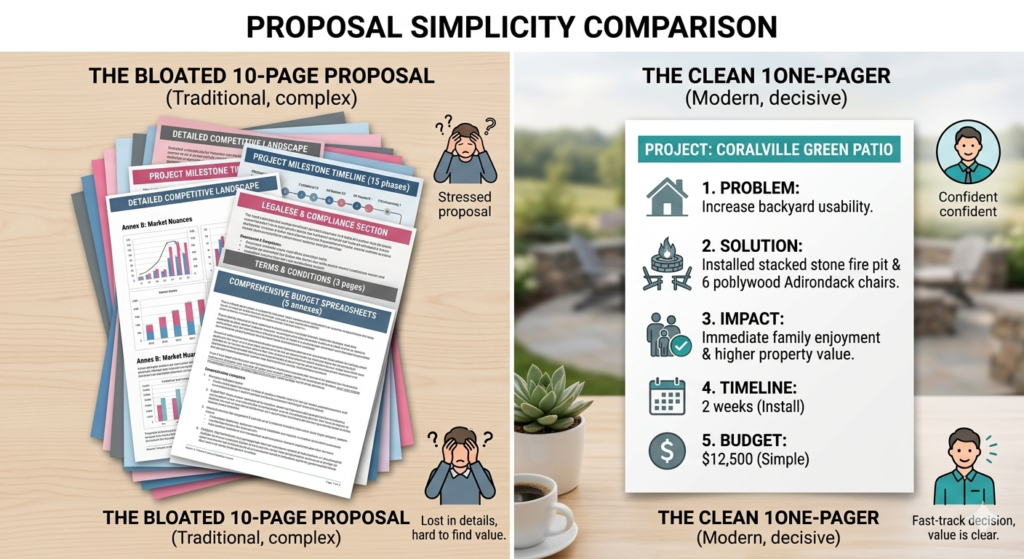
Here’s what happened: You sent a document that required them to do work. They had to read 10 pages. Discuss it with others. Compare it to other options. Make a decision.
That’s too much friction.
I learned this the hard way. I sent beautiful, detailed proposals. Close rate: 20%.
Then I switched to one-page proposals. Close rate: 60%.
Same projects. Same pricing. Different format.
Let me show you how.
Why Long Proposals Fail
Here’s the problem with traditional proposals:
Problem #1: Nobody reads them
You spent 5 hours writing 10 pages.
They spend 2 minutes skimming it. Maybe.
They look at the price. Then they close it and say “I’ll review this later.”
Later never comes.
Problem #2: They create decision fatigue
The more you write, the more questions you raise.
“Wait, what’s the difference between Phase 2 and Phase 3?”
“Do we need all of this?”
“What if we just do the first part?”
More detail = more doubt.
Problem #3: They invite comparison shopping
When you send a detailed proposal, they think: “I should get a few other proposals to compare.”
So they reach out to 2-3 other consultants.
Now you’re in a bidding war. And you might not even know it.
Problem #4: They get forwarded to people who weren’t on the call
Your proposal goes to someone who doesn’t know you. Doesn’t have context. Doesn’t understand the problem.
They see the price and say: “Why are we paying this much?”
Your proposal is now being judged by someone who doesn’t have the full story.
The One-Page Proposal Structure
Here’s what goes on the page. Nothing more. Nothing less.
SECTION 1: Header (Your Info)
Keep it simple:
[YOUR NAME]
[Your Title: Operations Consultant]
[Email] | [Phone] | [LinkedIn URL]
[Date]
That’s it. No logo. No fancy formatting. Clean and professional.
SECTION 2: The Problem (2-3 sentences)
Start by restating their problem in their words:
“As we discussed, [Company] is experiencing operational bottlenecks as you scale from 50 to 100 employees. Communication is breaking down between departments, projects are falling through the cracks, and leadership is spending too much time firefighting instead of leading.”
Why this matters:
It proves you listened. It reminds them why they need help.
Use their language, not yours. If they said “chaos,” use “chaos.” If they said “firefighting,” use “firefighting.”
This is not the place to be clever. Mirror their words.
SECTION 3: The Outcome (2-3 sentences)
State what success looks like:
“The goal is to implement systems and processes that allow [Company] to scale smoothly to 100+ employees without losing quality, speed, or culture. You’ll have clear cross-departmental communication, defined ownership for all major initiatives, and leadership freed up to focus on growth rather than daily fires.”
Why this matters:
They need to visualize the end state. What does “fixed” look like?
Paint the picture of what they get.
SECTION 4: The Approach (Bullet Points)
Outline how you’ll achieve this—in 3-5 simple steps:
Here’s how we’ll get there:
– Phase 1: Operational Audit (Weeks 1-2)
– Interview key stakeholders
– Map current processes and identify bottlenecks
– Deliver diagnostic report with findings
– Phase 2: System Design (Weeks 3-4)
– Create communication protocols
– Define roles and responsibilities
– Build project tracking framework
– Phase 3: Implementation (Weeks 5-8)
– Roll out new systems with your team
– Train managers on new processes
– Establish metrics for ongoing success
– Phase 4: Optimization (Weeks 9-12)
– Monitor adoption and troubleshoot
– Refine based on feedback
– Handoff to internal ownership
Why this matters:
They can see the path. It’s clear. It’s not overwhelming.
Four phases. Twelve weeks. Simple.
SECTION 5: Timeline
One line:
“Timeline: 12 weeks, starting [proposed start date]”
That’s it.
SECTION 6: Investment
Be direct. State the number.
“Investment: $18,000”
Or, if you’re offering payment options:
“Investment: $18,000 ($6,000 upon signing, $6,000 at week 4, $6,000 at week 8)”
Why this matters:
No surprises. No “call for pricing.” They already know this number from the discovery call.
You’re confirming what you already discussed.
SECTION 7: What’s Included
Brief list of key deliverables:
What’s included:
– Weekly check-ins with leadership team
– Diagnostic report with findings and recommendations
– Custom communication protocols and templates
– Manager training sessions (2 x 90 minutes)
– Project tracking framework and documentation
– 30-day post-project support
Why this matters:
They know exactly what they’re getting. No ambiguity.
SECTION 8: Next Steps
Tell them exactly what to do:
“If this looks good, reply to this email with ‘Approved’ and I’ll send over the agreement to sign. We can start [proposed start date].”
Or:
“To move forward, sign below and return this document. I’ll send the agreement and we’ll kick off [date].”
Include a signature line:
Approved by: _________________________ Date: _________
[Their Name, Title]
Why this matters:
You’re making it ridiculously easy to say yes. One word. One signature.
No “let me think about it.” No “I’ll discuss with the team.”
You’re asking for a decision. Now.
The Complete Template (Copy This)
Here’s the full template you can customize:
[YOUR NAME]
[Your Title]
[Email] | [Phone] | [LinkedIn]
[Date]
PROPOSAL FOR [CLIENT COMPANY]
The Challenge:
As we discussed, [Company] is experiencing [problem in their words]. [Specific impact on business].
The Outcome:
The goal is to [desired end state]. You’ll have [specific benefits they care about].
The Approach:
Here’s how we’ll get there:
- Phase 1: [Name] (Timeline)
- [Key activity]
- [Key activity]
- [Deliverable]
- Phase 2: [Name] (Timeline)
- [Key activity]
- [Key activity]
- [Deliverable]
- Phase 3: [Name] (Timeline)
- [Key activity]
- [Key activity]
- [Deliverable]
Timeline: [X weeks/months], starting [date]
Investment: $[Amount]
[Optional: Payment terms]
What’s Included:
- [Key deliverable]
- [Key deliverable]
- [Key deliverable]
- [Key deliverable]
- [Support/follow-up]
Next Steps:
If this looks good, reply with “Approved” and I’ll send over the agreement. We can start [date].
Approved by: _________________________ Date: _________
[Their Name, Title]
That’s the entire proposal. One page.
The Psychology Behind Why This Works
- It removes decision fatigue
One page. Five minutes to read. Clear yes or no.
They don’t need to “review it with the team” because there’s nothing to review. It’s simple.
- It creates urgency
When you ask for a decision NOW (“reply with ‘Approved'”), they make one.
When you say “take your time,” they put it off forever.
- It proves confidence
A 10-page proposal says: “I need to convince you.”
A one-page proposal says: “We already agreed on this. Here’s the confirmation.”
Confidence sells.
- It prevents comparison shopping
When they get your proposal, they can decide immediately.
They don’t have time to reach out to three other consultants and compare.
Speed wins.
- It matches the discovery call energy
You had a great conversation. They were excited. You were excited.
A 10-page proposal kills that energy. It feels like homework.
A one-page proposal maintains the momentum.
Strike while the iron is hot.
Common Questions (Answered)
“What if they want more detail?”
They won’t. And if they do, you can add it later.
But 95% of the time, this is all they need.
Remember: They were on the discovery call with you. They already know the details.
This proposal is a confirmation, not an education.
“What about terms and conditions?”
Send those separately in the contract they sign.
The proposal is not a legal document. It’s a summary of what you agreed to.
Keep legal stuff out of the proposal.
“What if the project is really complex?”
Still one page.
Just make your phases more general:
“Phase 1: Discovery and Planning”
“Phase 2: Design and Build”
“Phase 3: Implementation”
“Phase 4: Optimization and Handoff”
Complexity doesn’t require more pages. It requires clearer thinking.
“Should I include case studies or testimonials?”
No.
If they needed that, you wouldn’t have gotten to the proposal stage.
They already trust you (or they wouldn’t be considering hiring you).
This proposal is about the work, not about you.
When to Send It
Timing matters.
Option 1: During the call (best)
At the end of the discovery call, if they’re ready:
“Great. Let me put together a one-page summary of what we just discussed. I’ll have it to you by end of day. Sound good?”
Send it within 4 hours. While the conversation is fresh.
Option 2: Within 24 hours (good)
If you need a night to think through pricing or scope:
“Perfect. Let me put this together and I’ll send it to you tomorrow morning.”
Send it first thing the next day.
Option 3: Never (bad)
“Let me think about this and get back to you next week.”
No. Strike while the iron is hot.
The Follow-Up (If They Don’t Respond Immediately)
If you send the proposal and don’t hear back in 24 hours:
Email:
“Hey [Name], just wanted to make sure this landed okay. Any questions? If it looks good, just reply ‘Approved’ and we can get started.”
If still no response after 48 hours:
Email:
“Hi [Name], I know you’re busy. Is this still a priority? If timing isn’t right, no worries—just let me know and we can revisit later.”
Give them an easy out. But ask for a decision.
What Success Looks Like
Here’s what happens when you send one-page proposals:
✅ Faster decisions (24-48 hours instead of 2 weeks)
✅ Higher close rates (60% instead of 20%)
✅ Less back-and-forth (they know what they’re getting)
✅ Fewer “let me think about it” (momentum stays high)
✅ Clearer client expectations (no ambiguity about scope)
You close more deals. Faster. With less stress.
Your Assignment
Create your one-page proposal template today.
Use the structure I gave you:
- Header
- Problem (2-3 sentences)
- Outcome (2-3 sentences)
- Approach (3-5 phases, bullet points)
- Timeline (one line)
- Investment (one line)
- What’s Included (bullet list)
- Next Steps (clear ask + signature line)
Save it as a template.
Next time you have a discovery call that goes well, customize this template and send it within 24 hours.
Watch what happens.
Talk Tomorrow
Tomorrow, we’re talking about pricing—how to set your consulting rates so you’re profitable without undercharging or scaring clients away.
Hit reply and tell me: Have you been sending long proposals or short proposals? And what’s your close rate?
I want to know if this is where you’re losing deals.
And if you know a consultant who’s stuck in proposal purgatory—sends them, never hears back—forward this to them. One page changes everything.
— Bob
P.S. The signature line at the bottom isn’t just decoration. It’s psychological. When they see that blank line, they’re already visualizing signing it. That moves them closer to “yes.”
SUBSTACK CATEGORY SUGGESTIONS:
Primary Category: Proposals & Contracts
Tags/Secondary Categories:
- Sales Process
- Client Agreements
- Consulting Proposals
- Closing Deals
- Business Documents
SEO METADATA (If Using as Blog Post):
Meta Title: One-Page Consulting Proposal Template (60% Close Rate vs 20%)
Meta Description: Stop sending 10-page proposals that get ignored. This one-page proposal format gets decisions in 24 hours and converts 60% of prospects into paying clients.
Focus Keyword: one-page proposal template, consulting proposal, short proposal format, proposal that gets signed, consulting agreement, simple proposal template