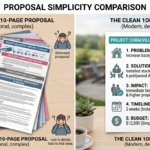

Someone says “Tell me more about what you do.” You panic. You ramble. You oversell. They say “I’ll think about it” and disappear. Here’s the proven framework that turns conversations into contracts—without feeling pushy.
The Call That Makes or Breaks Everything
You did it. You sent the re-connection emails. Someone responded.
“Hey, this sounds interesting. Can we set up a call?”
You say yes. You schedule it. You hang up the phone.
And then the panic sets in.
What do I say? How long should it take? Should I send them something first? What if they ask about price? What if I sound like I don’t know what I’m doing?
So you do what most people do: You wing it.
The call happens. And it’s a disaster.
You ramble about your background for 15 minutes. They politely listen but their energy drops. You oversell your expertise and sound desperate. They ask about pricing and you fumble. They say “This is helpful, let me think about it” and you never hear from them again.
I’ve been there. I’ve blown dozens of these calls.
Then I learned a framework. A structure. A way to run these calls that converts 50% of prospects into paying clients.
Not 5%. Not 10%. Fifty percent.
I’m going to give you that framework today.
Why Most Discovery Calls Fail
Let me show you what most people do wrong:
Mistake #1: You talk too much about yourself
The prospect asks: “Tell me about your background.”
You launch into a 10-minute monologue about your career history, every job you’ve had, every company you’ve worked for, every certification you’ve earned.
Their eyes glaze over.
They didn’t call to hear your resume. They called because they have a problem.
Mistake #2: You pitch too early
Five minutes into the call, you’re already selling.
“Here’s what I can do for you… I have a process that… My approach is…”
They’re not ready to hear this yet.
They barely know if you understand their problem. And you’re already telling them how to solve it.
Mistake #3: You don’t ask enough questions
You assume you know their problem. So you jump to solutions.
“Oh, I’ve dealt with this before. What you need to do is…”
But you don’t actually know their specific situation. Their constraints. Their goals. What they’ve already tried.
So your solution sounds generic.
Mistake #4: You end with “I’ll send you a proposal”
The call wraps up. You say: “This sounds great. Let me put together a proposal and I’ll send it over.”
They say “Sounds good” and you never hear from them again.
Because “I’ll send you a proposal” is where deals go to die.
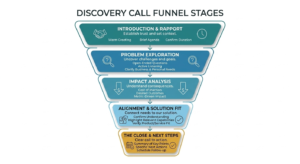
The 7-Phase Discovery Call Framework
Total time: 45 minutes (not an hour, not 30 minutes—45 is the sweet spot)
Here’s exactly how to structure it:
PHASE 1: RAPPORT (2 minutes)
Goal: Make them comfortable. Show you’re human.
What to say:
“Hey [Name], good to see you! How’s your week going?”
[Let them answer. Actually listen.]
“Thanks for making time. I know you’re busy.”
Small talk for 2 minutes. No more. No less.
Topics that work:
- How they know your mutual connection
- Something from their LinkedIn (recent post, news about their company)
- Weather/season if you’re both local
- Nothing too personal (no politics, religion, or complaints)
Why this matters:
People buy from people they like. Two minutes of genuine human connection matters.
But don’t do 10 minutes of small talk. You’re both busy. Move on.
PHASE 2: AGENDA SETTING (1 minute)
Goal: Set expectations for the call.
What to say:
“Here’s what I’d like to do with our time:
First, I’d love to hear your story—what’s going on with [situation], what you’ve tried, what’s working and what’s not.
Then I’ll share how I typically help companies in similar situations, and we can figure out if it makes sense to work together.
Sound good?”
Why this matters:
You’re taking control without being pushy. They know what to expect. You both have a roadmap.
This 1-minute agenda prevents awkward silences and wandering conversations.

PHASE 3: THEIR STORY (10 minutes)
Goal: Let them talk. Understand the situation.
What to say:
“So tell me—what’s going on? What made you want to have this conversation?”
Then shut up. Let them talk.
Your job for the next 10 minutes:
- Listen
- Take notes
- Ask clarifying questions
- Don’t interrupt
- Don’t jump to solutions
Questions to ask if they need prompting:
- “How long has this been going on?”
- “What have you tried so far?”
- “What’s working? What’s not?”
- “How is this affecting the business?”
Why this matters:
This is where most consultants fail. They don’t listen. They’re already formulating their pitch.
But the prospect needs to feel heard first.
And you need to actually understand their situation before you can help.
Listen more than you talk in this phase.
PHASE 4: DEEP DIVE (15 minutes)
Goal: Diagnose the real problem (not just the symptom).
What to say:
“Okay, let me ask you some questions to make sure I really understand what’s happening…”
Now you ask diagnostic questions:
About the problem:
- “When did you first notice this was an issue?”
- “What triggered it? Any specific event or change?”
- “How is this impacting [revenue/productivity/morale/timeline]?”
About what they’ve tried:
- “What have you already done to address this?”
- “Why do you think that didn’t work?”
- “What’s stopping you from solving it internally?”
About their goals:
- “What does success look like to you?”
- “If we fix this, what changes?”
- “What happens if you don’t fix it?”
About their constraints:
- “What’s your timeline?”
- “Who needs to be involved in this decision?”
- “What’s your budget range for solving this?” (Yes, ask this. We’ll cover it below.)
Why this matters:
You’re demonstrating expertise by asking smart questions they haven’t considered.
You’re uncovering the real problem (which is often different from what they think it is).
And you’re setting up your solution to be exactly what they need.
This is the most important phase. Don’t rush it.
PHASE 5: IMPACT QUANTIFICATION (5 minutes)
Goal: Help them see the cost of the problem (and the value of solving it).
What to say:
“Let me make sure I understand the impact here…”
Then reflect back what you heard—with numbers:
“So right now, you’re losing about [X deals/hours/dollars] per [week/month/quarter] because of this issue. Is that about right?”
[They confirm or correct.]
“And if this continues for the next 6-12 months, we’re talking about [$XX,XXX] in lost revenue/wasted time/opportunity cost?”
[They do the math and realize how expensive the problem is.]
Why this matters:
Most prospects underestimate the cost of their problem. You’re helping them see it clearly.
And when they see the problem costs $50,000 a year, your $10,000 fee suddenly seems like a bargain.
You’re building the ROI case before you’ve even pitched.
PHASE 6: YOUR APPROACH (5 minutes)
Goal: Show them how you solve this (without overwhelming detail).
What to say:
“Based on what you’ve shared, here’s how I’d approach this…”
Then outline your solution in 3-5 steps:
“First, I’d [diagnostic step].
Then I’d [solution design step].
Next, we’d [implementation step].
Finally, we’d [measurement/handoff step].”
Give them the what, not the how:
“I’d audit your current process and identify the 3-5 bottlenecks” → Good
“I’d use a SIPOC diagram to map value streams and apply lean six sigma methodology to…” → Too much. They don’t care.
Share 1-2 brief examples:
“I did something similar with a company in [industry]. They were dealing with [similar problem]. We [what you did], and they saw [result].”
Why this matters:
You’ve diagnosed their problem. Now you’re showing you have a clear path to solve it.
Brief. Confident. Not a detailed proposal. Just enough to show you know what you’re doing.
Five minutes. No more.

PHASE 7: THE CLOSE (7 minutes)
Goal: Get commitment or next steps—not “I’ll send a proposal.”
Here’s where most people fail. Here’s what to do instead:
Option A: If it’s clearly a fit and they’re ready:
“Based on what we’ve talked about, I think I can definitely help you with this. What I’d suggest is a [timeline] engagement where we [deliverables]. Investment would be in the range of [$X,XXX to $XX,XXX] depending on scope.
Does that feel like the right fit for what you need?”
[Wait for their response.]
If yes: “Great. Let me put together a one-page proposal with the details and we can get started next week. Sound good?”
If hesitation: “What concerns do you have?” [Address them.]
Option B: If you need more information:
“This is helpful. Before I can give you a clear recommendation, I’d need to [see X, talk to Y, understand Z]. Can we schedule a follow-up call after I [do that thing]?”
Option C: If it’s not a fit:
“Based on what you’ve shared, I don’t think I’m the right fit for this. What you really need is [different type of consultant/internal solution/different approach]. But I’d be happy to introduce you to someone who specializes in that.”
Why this matters:
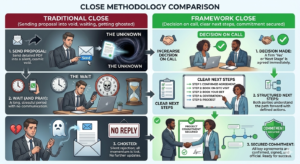
You’re making a decision on the call. Not “I’ll think about it.” Not “I’ll send a proposal into the void.”
You’re either moving forward, scheduling next steps, or politely declining.
This is how you get to 50% close rate.
The Money Question: When to Talk About Price
Most people avoid talking about price. Big mistake.
You need to know if they can afford you before you invest hours in a proposal.
Here’s when and how to bring it up:
During Phase 4 (Deep Dive), ask:
“What’s your budget range for solving this?”
If they say “I don’t know”:
“That’s fine. Let me give you a range so you know if we’re in the same ballpark. For projects like this, I typically work in the [X,XXX to $XX,XXX] range depending on scope. Does that feel reasonable for solving a problem that costs you [ XXX,XXX] a year?”
If they say a number:
Listen. If it’s in range: “That sounds workable.”
If it’s too low: “Got it. To be transparent, my typical engagements for this kind of work are in the [$X,XXX to $XX,XXX] range. That might be higher than what you’re thinking. Want to talk through what’s possible in your budget?”
Why this matters:
If they can’t afford you, you both need to know that NOW. Not after you spend 5 hours on a proposal they’ll never approve.
Price conversations are not awkward when you tie them to value.
“This problem costs you $50,000 a year. Fixing it for $10,000 is a no-brainer, right?”
What Converts and What Doesn’t
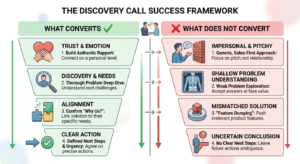
After running hundreds of these calls, here’s what I’ve learned:
What Converts:
✅ Listening more than talking (60/40 ratio)
✅ Asking great questions that they haven’t considered
✅ Quantifying the impact of their problem
✅ Being direct about price early
✅ Asking for the decision on the call
✅ Sharing 1-2 brief, relevant examples
✅ Having a clear process they can visualize
What Doesn’t Convert:
❌ Talking about yourself for 15 minutes
❌ Jumping to solutions before understanding the problem
❌ Overwhelming them with jargon or detail
❌ Avoiding the money conversation
❌ Ending with “I’ll send a proposal”
❌ Being vague about timeline or deliverables
❌ Overselling or sounding desperate
Your Assignment
Create your discovery call script.
Use the 7-phase framework:
- Rapport (2 min)
- Agenda (1 min)
- Their Story (10 min)
- Deep Dive (15 min)
- Impact (5 min)
- Your Approach (5 min)
- Close (7 min)
Write out:
- Your agenda-setting statement
- 10 diagnostic questions for Phase 4
- Your solution outline for Phase 6 (3-5 steps)
- Your closing question
Then practice it.
Record yourself. Listen back. Refine.
Don’t wing these calls. Have a framework.
The difference between 10% close rate and 50% close rate is structure.
Talk Tomorrow
Tomorrow, we’re diving into proposals—how to create a one-page proposal that gets signed in 24 hours instead of disappearing into a black hole.
Hit reply and tell me: What phase of the discovery call do you struggle with most? I want to know where you get stuck.
And if you know someone who’s getting on calls but not closing, forward this to them. Framework beats winging it every single time.
— Bob
P.S. The Phase 5 (Impact Quantification) is where I see the biggest change in prospects. When they realize their problem costs $50K a year, suddenly a $10K solution seems obvious. Don’t skip this step.